Showing posts with label environmental art. Show all posts

Wednesday, 9 March 2016

Soap operas (AGAIN!!!) and cult TV

Soap Operas and Cult TV shows are circular economies, if you will.
Part of some TV show’s ‘cultness’ is that they are open to ongoing aesthetic analysis as their history lengthens, and thus they are a reflection of people. Often they have collective audiences to enjoy experiencing and responding to the shows together, whether they sit together in the same room to watch them, or are part of a fan club of sorts, of simply enjoy the idea that others around the country or the world are all sitting down at the same time to watch the same show.
Fans of these shows feedback actively (buy memorabilia, endlessly drop quotes into conversation, take life lessons from them, make fan art/zines etc, re-watch and re-watch) and so the legacy of the TV show plays on its audience’s participation. It’s a feedback loop.
Let me say that again – the legacy depends on our feedback, or our response.
Now think of that in relation to planet earth.
The legacy of planet earth depends on our feedback into it… the way we inhabit our environment. Our response to it.
So the way we engage with cult TV shows and soap operas is a familiar behavioural process, and can offer an insight into a very similar behavioural process that ought to employ in our daily life in the environments of planet earth.
It’s a reciprocal, adaptive process.

The vision of people engaging in cult TV/soap operas can serve up a visual motif around which to construct a social message (possible even political) about care for the environment.
There is a social and psychological agenda in the assembled visuals within and surrounding a TV show. If dissected and analysed, those visuals can bring up a rallying cry of seductive social options for us. We are now presented with the assembled symbolic visuals of our social options. Soap operas are particularly good at this because they are ongoing and situated in everyday scenarios.

As part of my ‘film’ I will include a soap opera which all the characters are a fan of. 
They will gather nightly under the baobab tree in the still heat of the desert twilight to watch it together. They will all hum the theme tune as the opening credits begin.
One of them drinks from her fan mug that had a cheesy picture of three of the soap opera’s characters emblazoned on it. One of them will continually quote familiar turns of phrase that they have come to hear regularly from one of the soap operas longest-running characters. This is twenty minutes of peaceful escapism for them at the end of each day.

Soap worlds are small, concentrated, local in audience mentality but also in content, people become obsessed, or then they’ve never heard of them! It’s a personal attachment and small scene. A local scale. Supportive and caring. Like a small-holding farm. They are sequential and cotton onto real life, and are there for you and keep going. Their broadcasting pattern is that of a serial, sustainable, small-dose one. They are open-ended. This is good as a metaphor for living locally and sustainably on earth.
Soaps are also super accessible and hold a special place in so many peoples’ timelines even if they claim to dislike them. Many of us remember watching them with a parent or grandparent as a child, idealising alongside older generations, all feeling their own on-screen counterpart’s resonance, and all learning. Soaps are familiar - a shared experience, nothing new, nothing risky, nothing uncomfortable or high-brow or demanding.
Soaps have a kind of ‘all under one roof’ vibe; there is something for everyone. They summarise and tie in family and community so easily. This is a vibe of care and sustainable relations; that which we ought to carry through into our environmental lives on earth.

And soap characters test the limits of personal human pomp, expansion and delusion safely, while keeping it all at arms length, and to act as a warning to us all.
But they can also demonstrate perfection in such wonderful light that we may feel ever more seduced, if it weren’t for the episodic trundling and thus predictable flaws of downfall, ruts and demise (and rebirth) of all characters depicted. Perfection is always saturated and counteracted in soap opera, making them all the more safe a viewing experience for out egos, and thus society and the planet.
As Pauline Kael said in her review of the film 'Funny Girl';
"In life, fantastically gifted people, people who are driven, can be too much to handle; they can be a pain. In plays, in opera, they're divine, and on the screen, where they can be seen in their perfection, and where we're even safer from them, they're more divine."

The aim of the soap opera as a decipherable motif in my ‘film’ is to mobilise a personal response in the viewing process and to invite thought. It will act as a sub-text, to be imaginatively extended by the viewers of my ‘film’ (which will be depicted through freeze-frame paintings, prints and drawings, some of which will include written elements in the form of dialogue or quotes, set direction or credits/opening sequences). The soap opera’s location and plot will not be evidently revealed, but will simply exist in a place-less place. This is because a place-less place-ness can be more relatable and subjective, allowing itself to be accessed through a viewer’s personal experience. Perhaps some attention will divert to the context of the artist (me) and the soap opera’s subjective scenarios can play on an inter-textuality with my other work – which is often about our place in the environment, and the power of imagination in learning to behave towards the planet (and our dreams/ambitions). Perhaps I can even rely further on inter-textuality made available to me by famous films or moments of environmental precarity/disaster/salvation such as Exxon Valdez.

An instance where a soap opera is used inside a film is the film ‘Joy’ (2016), where Russell creates a fanciful element to the film by using the ongoing viewing of a soap opera to mirror the ups and downs of the actual film’s main character. (the director)

Overall my ‘film’ and its soap opera ought to function as an immediate signifier experience (possibly embodied experience if senses can be appealed to, which I think I can do!) experience, which one will be invited to deconstruct. This invitation to delve for further meaning can be achieved by many means, namely using cinematic devices in the images to suggest continuing/preceding events outside of the frame, in order to get the viewer’s imagination to work. It can also be achieved by withholding one element of an otherwise full picture, or by offering a strong beginning of a narrative in an otherwise abstract image.

The audience will have to work, and will know that I have some sort of agenda.
It can be a dialectic experience, as indeed is every assemblage of characters in a soap opera or film.

*

Passion in cinema:

I also simply want to pay homage to the way cinema-going offers a reflection on our own lives and also an escape from it, so I will use the cinema setting/stage set and film techniques (subtitles, doubling, layering, multiple view points, panning, screen dimensions, lighting and colour, soundtrack etc) to allude to the persuasive power of cinema.

Passionate cinema is when you experience one of two things:
1.     You feel so strongly, and the feeling lingers after you leave the cinema/film ends. You feel you need to call a certain person, do a certain thing, have everyone leave you alone so you can ride the feeling out.
2.     You have a strong sensory journey, but the message/meaning/results is ambiguous and you need someone else to see it, either to help you understand, or for you to be able to ‘own’ that moment you don’t understand or are scared by in your showing it to someone else; your ‘knowing’ of it.

In an interview at the BFI Viggo Mortensen quotes another actor (it isn’t quite clear whom) on what makes a film epic…
- “I want people to wake up in the middle of the night and think that everything they are doing is wrong”.
That feeling of needing to enrich or change your life is amazing.
Drive is such a seductive quality in humans.
If a film can reinvigorate your own drive, then the world would be full of interesting, driven, accomplished, independent, free-thinking people. How wonderful.

***

Anyway here's some recent studio work in progress stuff/ 
Themes:
Film opening title sequence / monument to endangered species / blind monk seals of Hawaii / archipelagos / radio power / soap operas (clearly) / pop fashion trends / technology fascinates but obstructs our mobility and proactivity: - we become inert.




p.s listen to the podcast Pop Culture Salvage Expeditions - find it on itunes or on the link. Great resource for artist activists, and of course via the theme of my beloved pop culture!

p.p.s Listen to Brian Fallon's debut solo album 'Painkillers' when it's out on Friday 11th March on Island Records. I feel emotional just reading this review of it by Craig Manning on absolutepunk.net

p.p.s It's Country2Country music festival this coming weekend in London and Glasgow, which i'm going to, so if ya fancy some country pop then listen to Kip Moore, Eric Church's new album, Hannah Aldridge and generally catch up on Bob Harris's Country show on Radio 2. Especially this episode with Thomas Rhett in session, he's great in convo with Bob and super interesting in his writing process.

Oh and I updated my artists statement recently, it was a bit waffley before....


Thursday, 18 February 2016

Bits and pieces: sketches and catching up on indigenous cultural and environmental news.

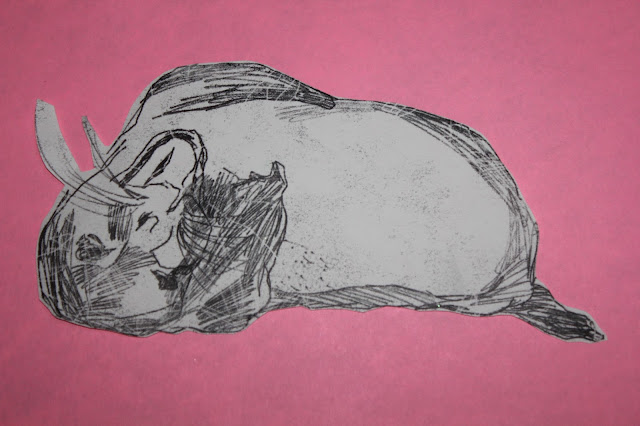
I've been making so many sketches, ink paintings, mono-prints, and writing pieces of flash fiction which seem to be serving as character treatments/back stories for the characters in film (of which there are so far 7 and two are non-human: A wolf that can't swim, and the haunted ocean).

Here are a small selection of some of those bits and pieces - but i've taken photos of some of it through some plants to hide bits cos I'm so excited I don't want to give things away until June when I put my show up (although I'm vert aware that this project is a massive one and that I won't have things up to a satisfactory standard (aesthetically and in terms of communicating my message fully) by June so I think i'll need to focus on one or two characters, one or two film locations and one or two dialectics/strands of story to try and represent for then. I'll try to make it into a wholesome show, that people can enjoy and learn from independently from the overall film project.


Dom loves Scarlett


This is a screen print I made in my last year at uni. Cool huh? It's a still from a film I made which shows a man (Dom) drumming in response to a projected video on the wall which I made of (that white shadow you can just make out) of a woman bellydancing. Read about that project here. And watch the video too!


and I loves Grimes and the Singapore Botanic Gardens


This a sketch/idea for a monument in The Swaglands, for my film


Script and screenplay grabs from social media, books, songs - all pieced together to implicate us all into the narrative of post-Colonial climate activism and issues. I think it's important to use pop culture references and genres (such as punk, street, gothic, contemporary fiction and soap operas as these are all products of culture and referencing both implicates that scene and the producers of that culture, as well as engaging niche and youth audiences, and also heightening the relevance and urgency and 'everyday' of the problem of environmental poverty and Colonial legacy.

Outfit/costume studies for my film's new character (currently called Molly) who is a Chinese lady whose family died from respiratory diseases and cancer due to living in a literal toxic wasteland in an isolated Chinese industrial town. She then left home, started walking, and found herself in The Swaglands.


I've also been catching up with indigenous environmental and social politics and indigenous culture news (I got distracted by watching some Simon Reeve BBC documentaries - especially the Greece ones - and also submerging myself in a pool of Americana music) and as well as my trusty old sources i've found some really engaged/engaging new magazine and media channels. I'll put links to all of them here because (as I said in my last post - if you are an artist, or general practitioner in the culture realm then you should know how the institutions that support your career and future are funded, and what that funding means for the environment and indigenous lifestyles, as well as how that funding shapes the meaning of 'creative freedom').
  • Briarpatch - A truly grassroots Canadian magazine on culture and politics.
  • Mispon Festival website - You can finds heaps of podcasts and film recommendations on here. They are an organisation based in Saskatchewan, Canada and run workshops for indigenous culture engagement, a yearly film festival, and generally publicise and promote indigenous filmmaking.
  • Broken Boxes podcasts looks at artists processes, and Art Beat Conversations (another think to look at!!) Episode 20 is about "This Is A Stereotype" which is an artist film about indigenous identity. 
  • RezX is a magazine and TV programme is basically (another Canada based) lifestyle critique and news platform. There's a good podcast on the Mispon website which interviews ResX's founder Chris Ross about how it started - he's a chiller and it sounded like a really fun creative party time! It's Episode #11. Listen!!
  • This is a great article about indigenous misrepresentation on Canadaland's website.
  • Access TV is a grassroots social media TV network based in Connecticut. So local news, cultural, social and political commentary, without corporate sponsorship. I think you cn weatch Episode 1 of ResX TV's show on here.
  • This is an online paper, and I can never quite tell who curates it exactly, but my recommendations and blog have been featured on it a few times. It free and monthly, and collects news and culture about indigenous and environmental issues. It's called Indigenous News.
  • And my fave new TV show (i've only seen two episodes) is Redfern Now, from 2012-2013, which is an indigenous Australian soap opera/family drama series which is based in the rough suburb of Redfern in Sydney . Here is episode 1. 

I've been considering how to write my screenplay/script and I know I don't want it to come from me entirely. I want to pull information, opinions and situations straight from the mouths of people who ARE implicated into situations that I am not in terms of social exclusion and environmental poverty. Because I can't assume to speak on behalf of anything or anyone that lives outside of my scope of experience and knowledge. The way to do this I think (this is how I am accessing those other opinions and stories...) through continuing to go to all the talks, seminars etc on environment/Colonialism/art and culture/indigenous rights that I go to and pulling from those. To also keep engaging on twitter, facebook etc with people and groups of people who CAN speak about the things I can't.

Something that Chris Ross says that helps to sum up my approach to writing my screenplay is that there are various types of knowledge; Street knowledge, Academic knowledge, Spiritual knowledge...
He thinks of spiritual knowledge as being the hidden section in the library that nobody goes to, but which contains all the teaching of history and creation. Ross explains that what he likes about social media is it can point those of us who don't know where to look or how to access that hidden section, in the right direction - social media tells you where to look: to the sources i've listed above. Very cool!
And I think that altough articles on those media platforms may be as close as many of us get to meeting with spiritual elder knowledge, but having the empathy is important.

*

I also try to keep up with contemporary art in London of course because I like to, and sometimes I find something really important and beautiful.
I bought a ticket to see Ben Rivers in conversation last Wednesday but I had to go to bed cos I had a migraine (I keep missing amazing things due to migraines!!). I also went to the RA Masters Interim show which was ok - but very segregated from real life. But then it's the RA Masters so of course the was probably likely!
I listened to this conversation with Maureen Paley which is fun and interesting and quite helpful for young London artists learning how to position themselves. Shame I don't have instagram Maureen! If ever I find I can spare the money to buy myself a Fairphone (literally does what it say on the tin - a smartphone made of environmentally and socially responsible components) I will get instagram. But I will NOT buy some blood-drenched i-phone thank you very much.

And as I don't have instagram I will share with you the things that inspire me that I would share on instagram if I had it:

Saturday, 6 February 2016

A small essay on the discomfort between art, colonialism and climate activism.

As an artist and an environmentalist, with an ongoing strong interest in indigenous rights (ever since I ventured to Australia as a naïve British teenager with a wad of cash from stacking shelves at M&S that I wanted to spend on beers at Bondi beach and bungee jumps – I quickly changed my outlook once I got there), I have always wondered how best to mesh these concerns and practices together to live a considerate lifestyle and to send a message using the one thing I feel at peace with and can’t stop doing – making art in my studio.
Initially, the first barrier is to question if I am being selfish in choosing to make art – does the world need more essentially pointless decoration and niche academia? I would initially say no, probably because my work isn’t particularly academic as much as it is emotive and fantastical. I find very niche academia (such as the concept of the object etc etc) interesting but in danger of being a little too removed from real life when there's so much rubbish to clear up!
But I’ve come round to an idea of thinking – yes: make what you like – if you can speak to just one person about something and be inclusive that way, then go for it. BUT there are three things we ought to look out for when placing ourselves in the art world (whether as an artist, curator, critic, educator…)
–      Don’t make people feel left out for not being ‘academic’ or ‘arty’ enough; who is anyone to say that someone is less creative and less interesting than anyone else?
–      Don’t waste physical or financial resources on making something that is really just in your own interest. i.e don’t fuel a segregated art and culture scene where only other learned people can engage. By all means create/engage in a locality surrounding your work, but don’t withhold resources from others in doing so.
–      And this is the MOST important…. Don’t forget how curated culture began. I’m kind of speaking to UK/USA/Australian first-worlders here) – It began as way to exoticise and preserve ‘prizes’ from the colonised world. That is how museums and galleries began. And museums and galleries are still assuming to speak on behalf of indigenous communities. It’s still a show. A colonial performance.

So – now that I have made known my issues with the way some people and institutions operate, I can relate this to the environment and indigenous rights.

We all know that much of public culture is sponsored by oil. For example, BP sponsors the British Museum, Total and Eni sponsor Le Louvre, and Shell, along with three major airlines are corporate partners with the BFI… to name just a few. Every large culture institution you can think of is pretty much sponsored by fossil fuels companies, banks that invest in fossil fuels, or companies linked with poor workers rights or unsustainable palm oil production (resulting in deforestation).
If you did not know that, read more here.

All artists ought to know this by now (even if they don’t care) otherwise they can consider themselves disconnected with mainstream life, and borderline irrelevant to the future. If you are an artist you need to know how your potential career may be funded, and also the responsibility to which you must be held in your awareness of the dirty, oily, disrespectful ‘pinnacle’ of the art world. Art is a free world (theoretically) but its infrastructure and financial system is shady and imprisoned by climate change and a legacy of human rights abuse.

So I want to look at a few different things
- How creativity and meaning may be altered or undermined once a cultural institution is involved in its production or display.
- The danger of viewing art in the context of a gallery.
- A type of approach to racially inclusive art practices.


So…Firstly: ‘how creativity and meaning may be altered or undermined once a cultural institution is involved in its production or display’

The explorers of Colonialism brought us back many rare and interesting curiosities; ritual objects, traditional dress, foreign art. Imperial artists were commissioned to paint representations of foreign lands and wildlife. Public galleries and museums were opened to show everyone how clever the Empire was, how fast it was expanding. They showed the power of the Empire, and how rich it was becoming due to the expanding trade routes and the exotic products we were gaining access to. Money and power were so glorious! And that’s how it has stayed ever since. Power may have relocated to an academic and ‘knowledge’ based currency, but Imperial money is still what keeps these museums and galleries going. And Imperial money comes from Colonialism. Colonialism met the Industrial age and issued a brutal demand for natural resources such as coal, oil and gas. Colonialism bought about the slave trade, displacement of indigenous people, theft and destruction of their homelands and indeed their health and dignity, elimination of their religions and spirituality, and all for the sake of power and money. And the power and money is something we still possess and can’t surrender. Our empire is still very much alive, but it’s now a Coca-cola Empire, A Shell Empire, A Nestlé Empire…
So the very fact that culture is funded by dirty money changes the meaning and our ‘knowledge’ of both history and culture. It changes the meaning of creativity when viewed with this in mind. The sponsors don’t want certain things to get out about their past, and indeed their present. Culture, if you like, is a way to sneakily fulfil corporate social responsibility. And if you push that to the back of your mind, you’re frankly saying you’re ‘ok’ to the fact that slavery, theft and destruction allowed culture to flourish.


Secondly - the danger of viewing art in the context of a gallery 
Now we know the narrative of art and culture (exploitation = ‘knowledge’ = power and money) we can’t deny it.
If one goes to the Tate Britain and sees the Artist and Empire exhibition which is now on, one will come away sickened. There is no mention of the actual social functions and the nature of the transactions between the world of art and the British Empire. It is simply a collection of Colonial-era objects and art, mainly from Western Imperial artists as well! We all know about slavery and mining, but even this is barely touched upon let alone examined in relation to how and why we are able to stand in that very room looking at art.
The entire exhibition is a de-contextualised from modernity, and completely subverts the idea that culture = knowledge. They are hiding the facts that allow the exhibition to even take place! They are not giving you the knowledge you went there for.
Viewing art in any gallery, let alone one sponsored by oil (and therefore a gallery that watches its mouth in relation to its Colonial legacy) upholds a dangerous narrative just by the very fact that we are viewing the art in isolation. We’re not considering the social constructs and events that happened to allow the money for the art to be produced, or for the paint pigment to be discovered, or for the oil-derivative sculpture material to be made and distributed, or for the carved wood to be cut and shipped. Last night I saw a panel discussion at the British Library chaired by David A Bailey, who posed the question that the ‘white cube’ art space is out of touch. I agree – it cannot allow art to fulfil its potential for truth, empathy and mobilisation of the public.

My last point is about a type of approach to racially inclusive art practices.
Many of us are aware of our nation’s Colonial past, and are careful to admire rather than use the discoveries about foreign cultures. However, having already had my suspicions about, and felt inherent discomfort about indigenous creativity being separated from white creativity, I attended a talk on Colonialism, Art and Climate change. This took place last weekend at Climate Rising in Euston. My suspicions were confirmed by a panel of artists and activists of colour: Black and brown artists are employed and studied as a representation of trauma and exoticism, and not as a creative human force within their own rights. Coloured artists are curated by white gallerists, curators and critics. Coloured artists are commodified – Western guilt is alleviated and forward-thinking is assumed when coloured artists are publicised or included in shows. White supremacy is still rife, even in the avenues in which we think it is not.
This type of approach is symptomatic of how white supremacy gets in the way of true change.
Oh and as additional reading take a look at this review of a show in the Netherlands that is currently on and displays art by artists from various african countries:
http://www.artslant.com/ams/articles/show/45022

My parting statement shall be:

Colonialism needs to be at the forefront of the climate movement ALWAYS, because the former colony lands are the ones that have suffered the most as a result of climate change (hotter, drier, poorer, wetter etc), and if white people in power dive in again without consulting indigenous populations then were are all back where we started. Indigenous communities such as the aborigines are the ones who know how to live on their land, we do not know how to live on their land. We don’t know their social constructs. We cannot assume to know more about how to help their situation than they do. Total control of their future must be given back t o them, because it should never have been taken away.

However. Although I do care about indigenous rights and climate change affecting them worst of all, I can’t escape the fact that I come across as a guilty white Brit. I cannot claim to know something outside the scope of my own experience. I do however think I am a good person, and empathetic. So I can imagine, and gain unsaturated knowledge by looking to the right sources. But I can’t EVER claim to speak for indigenous people. I just have to try and alert people like me for whom life is easier, to the issues at hand for the planet and indigenous people.
But I do NOT want to be eliminated in my helpfulness because I am white.
I have the advantage of being able to speak on this end of the phone – to the more advantaged people. Everyone has the ability to help, just in different ways.

There’s the saying ‘don’t preach to the converted’: Often human rights and climate issues are only reaching the converted. My aim is to reach the people on the cusp of caring, people who can get on board once they see things a bit clearer. My aim is also to push for giving indigenous people back their platform for freedom of speech and autonomy, by appealing to the background I came from.

***

And here are a few details of some paintings I am working on to represent my 'film' in 'stills' - read back a post or two through my blog if you want to know more. It is a film that is 100% about indigenous rights and the environment and personal aspirations - and how those things often clash.

For extra background check out this amazing lady Suzanne Dhaliwal who I have seen speak twice in the last week, and is so succinct and modern and intelligent. 
Also check out Platform a great organisation that covers all the thinks I've just spoken about, as does SHAKE! who are totally my kind of creative caring people.


I know there aren't many pictures on these last few posts, but I'm really excited about the art i'm starting to make now and I want it to be surprise for my exhibition in June.